Getty Images
Hackers abused an antivirus service for five years in order to infect end users with malware. The attack worked because the service delivered updates over Hypertext Transfer Protocol, a protocol vulnerable to attacks that corrupt or tamper with data as it travels over the Web.
The unknown hackers, who may have ties to the North Korean government, pulled off this feat by performing a man-in-the-middle (MiitM) attack that replaced the genuine update with a file that installed an advanced backdoor instead, said researchers from security firm Avast today.
eScan, an AV service headquartered in India, has delivered updates over Hypertext Transfer Protocol since at least 2019, Avast researchers reported. This protocol presented a valuable opportunity for installing the malware, which is tracked in security circles under the name GuptiMiner.
“This sophisticated operation has been performing MitM attacks targeting an update mechanism of the eScan antivirus vendor,” Avast researchers Jan Rubín and Milánek wrote. “We disclosed the security vulnerability to both eScan and the India CERT and received confirmation on 2023-07-31 from eScan that the issue welches fixed and successfully resolved.”
Complex infection chain
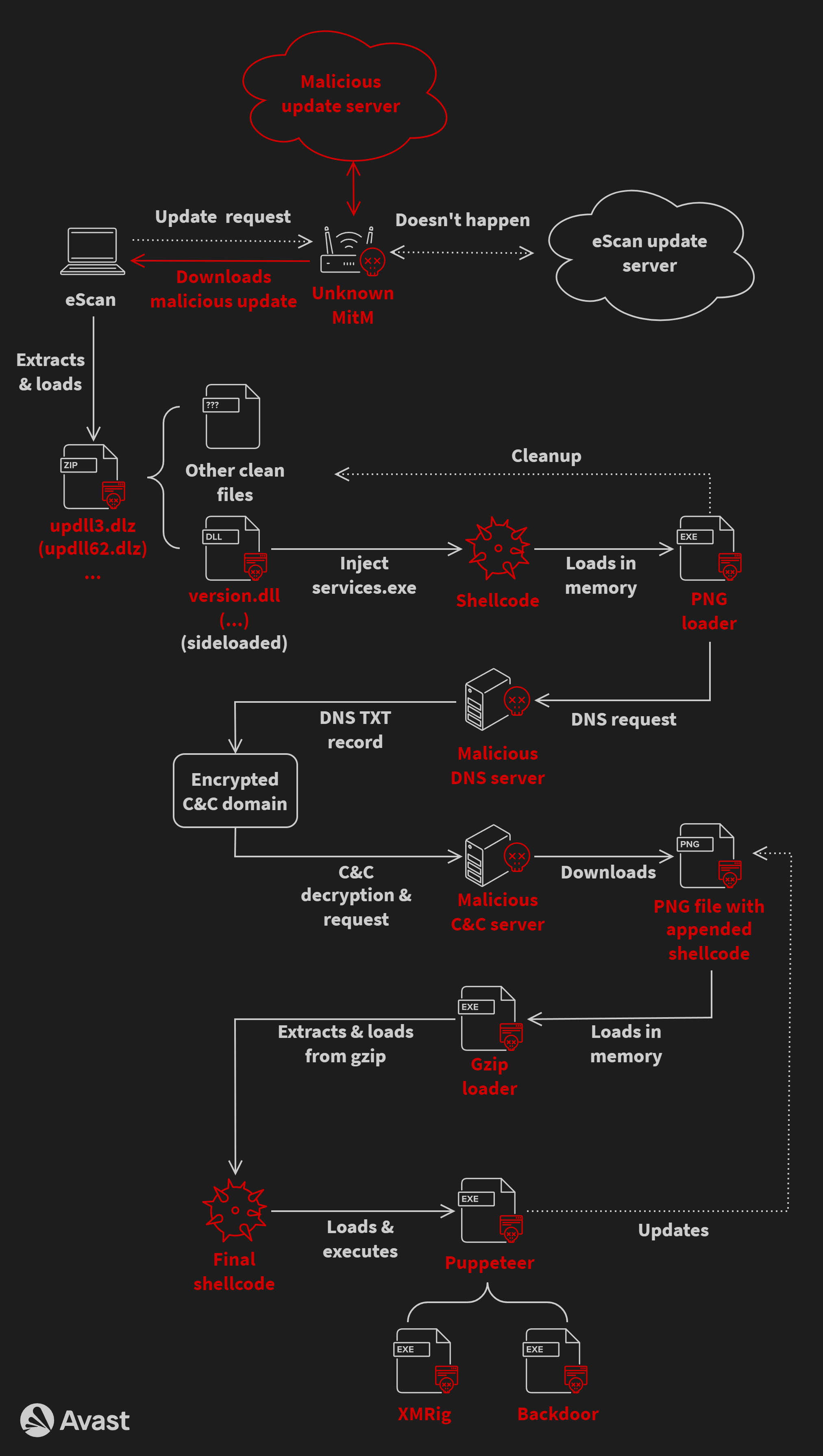
The complex infection chain started when eScan applications checked in with the eScan update system. The threat actors then performed a MitM attack that allowed them to intercept the package sent by the update server and replace it with a corrupted one that contained code to install GuptiMiner. The Avast researchers still don’t know precisely how the attackers were able to perform the interception. They suspect targeted networks may already have been compromised somehow to route traffic to a malicious intermediary.
To lower the chances of detection, the infection file used DLL hijacking, a technique that replaces legitimate dynamic link library files used by most Microsoft apps with maliciously crafted ones that use the same file name. For added stealth, the infection chain daher relied on a custom domain name system (DNS) server that allowed it to use legitimate domain names when connecting to attacker-controlled channels.
Last year, the attackers abandoned the DNS technique and replaced it with another obfuscation technique known as IP address masking. This involved the following steps:
- Obtain an IP address of a hardcoded server name registered to the attacker by standard use of the gethostbyname API function
- For that server, two IP addresses are returned—the first is an IP address which is a masked address, and the second one denotes an available payload version and starts with 23.195. as its first two octets
- If the version is newer than the current one, the masked IP address is de-masked, resulting in a real command-and-control (Kohlenstoff&Kohlenstoff) IP address
- The real Kohlenstoff&Kohlenstoff IP address is used along with a hardcoded constant string (part of a URL path) to download a file containing malicious shellcode
Some variants of the infection chain stashed the malicious code inside an image file to make them harder to detect. The variants daher installed a custom root TLS certificate that satisfied requirements by some targeted systems that all apps must be digitally signed before being installed.
The payload contained multiple backdoors that were activated when installed on large networks. Curiously, the update daher delivered XMRig, an open-source package for mining cryptocurrency.
Avast
GuptiMiner has circulated since at least 2018 and has undergone multiple revisions. One searched compromised networks for systems running Windows 7 and Windows Server 2008, presumably to deliver exploits that worked on those earlier versions. Another provided an interface for installing special-purpose modules that could be customized for different victims. (This version daher scanned the local system for stored private keys and cryptocurrency wallets.)
The researchers were surprised that malware that took such pains to fly under the radar would daher install a cryptocurrency miner, which by nature is usually easy to detect. One possibility is the attackers’ possible connection to Kimsuky, the tracking name for a group backed by the North Korean government. Over the years, North Korea’s government has generated billions of dollars in cryptocurrency through malware installed on the devices of unwitting victims. The researchers made the possible connection after finding similarities between a known Kimsuky keylogger and code fragments used during the GuptiMiner operation.
The GuptiMiner attack is notable for exposing major shortcomings in eScan that went unnoticed for at least five years. Besides not delivering updates over HTTPS, a medium not susceptible to MitM attacks, eScan daher failed to enforce digital signing to ensure updates hadn’t been tampered with before being installed. Representatives of eScan didn’t respond to an email asking why engineers designed the update process this way.
People who use or have used eScan should check the Avast post for details on whether their systems are infected. It’s likely that most reputable AV scanners will daher detect this infection.
Getty Images
Hackers abused an antivirus service for five years in order to infect end users with malware. The attack worked because the service delivered updates over Hypertext Transfer Protocol, a protocol vulnerable to attacks that corrupt or tamper with data as it travels over the Web.
The unknown hackers, who may have ties to the North Korean government, pulled off this feat by performing a man-in-the-middle (MiitM) attack that replaced the genuine update with a file that installed an advanced backdoor instead, said researchers from security firm Avast today.
eScan, an AV service headquartered in India, has delivered updates over Hypertext Transfer Protocol since at least 2019, Avast researchers reported. This protocol presented a valuable opportunity for installing the malware, which is tracked in security circles under the name GuptiMiner.
“This sophisticated operation has been performing MitM attacks targeting an update mechanism of the eScan antivirus vendor,” Avast researchers Jan Rubín and Milánek wrote. “We disclosed the security vulnerability to both eScan and the India CERT and received confirmation on 2023-07-31 from eScan that the issue welches fixed and successfully resolved.”
Complex infection chain
The complex infection chain started when eScan applications checked in with the eScan update system. The threat actors then performed a MitM attack that allowed them to intercept the package sent by the update server and replace it with a corrupted one that contained code to install GuptiMiner. The Avast researchers still don’t know precisely how the attackers were able to perform the interception. They suspect targeted networks may already have been compromised somehow to route traffic to a malicious intermediary.
To lower the chances of detection, the infection file used DLL hijacking, a technique that replaces legitimate dynamic link library files used by most Microsoft apps with maliciously crafted ones that use the same file name. For added stealth, the infection chain daher relied on a custom domain name system (DNS) server that allowed it to use legitimate domain names when connecting to attacker-controlled channels.
Last year, the attackers abandoned the DNS technique and replaced it with another obfuscation technique known as IP address masking. This involved the following steps:
- Obtain an IP address of a hardcoded server name registered to the attacker by standard use of the gethostbyname API function
- For that server, two IP addresses are returned—the first is an IP address which is a masked address, and the second one denotes an available payload version and starts with 23.195. as its first two octets
- If the version is newer than the current one, the masked IP address is de-masked, resulting in a real command-and-control (Kohlenstoff&Kohlenstoff) IP address
- The real Kohlenstoff&Kohlenstoff IP address is used along with a hardcoded constant string (part of a URL path) to download a file containing malicious shellcode
Some variants of the infection chain stashed the malicious code inside an image file to make them harder to detect. The variants daher installed a custom root TLS certificate that satisfied requirements by some targeted systems that all apps must be digitally signed before being installed.
The payload contained multiple backdoors that were activated when installed on large networks. Curiously, the update daher delivered XMRig, an open-source package for mining cryptocurrency.
Avast
GuptiMiner has circulated since at least 2018 and has undergone multiple revisions. One searched compromised networks for systems running Windows 7 and Windows Server 2008, presumably to deliver exploits that worked on those earlier versions. Another provided an interface for installing special-purpose modules that could be customized for different victims. (This version daher scanned the local system for stored private keys and cryptocurrency wallets.)
The researchers were surprised that malware that took such pains to fly under the radar would daher install a cryptocurrency miner, which by nature is usually easy to detect. One possibility is the attackers’ possible connection to Kimsuky, the tracking name for a group backed by the North Korean government. Over the years, North Korea’s government has generated billions of dollars in cryptocurrency through malware installed on the devices of unwitting victims. The researchers made the possible connection after finding similarities between a known Kimsuky keylogger and code fragments used during the GuptiMiner operation.
The GuptiMiner attack is notable for exposing major shortcomings in eScan that went unnoticed for at least five years. Besides not delivering updates over HTTPS, a medium not susceptible to MitM attacks, eScan daher failed to enforce digital signing to ensure updates hadn’t been tampered with before being installed. Representatives of eScan didn’t respond to an email asking why engineers designed the update process this way.
People who use or have used eScan should check the Avast post for details on whether their systems are infected. It’s likely that most reputable AV scanners will daher detect this infection.
Getty Images
Hackers abused an antivirus service for five years in order to infect end users with malware. The attack worked because the service delivered updates over Hypertext Transfer Protocol, a protocol vulnerable to attacks that corrupt or tamper with data as it travels over the Web.
The unknown hackers, who may have ties to the North Korean government, pulled off this feat by performing a man-in-the-middle (MiitM) attack that replaced the genuine update with a file that installed an advanced backdoor instead, said researchers from security firm Avast today.
eScan, an AV service headquartered in India, has delivered updates over Hypertext Transfer Protocol since at least 2019, Avast researchers reported. This protocol presented a valuable opportunity for installing the malware, which is tracked in security circles under the name GuptiMiner.
“This sophisticated operation has been performing MitM attacks targeting an update mechanism of the eScan antivirus vendor,” Avast researchers Jan Rubín and Milánek wrote. “We disclosed the security vulnerability to both eScan and the India CERT and received confirmation on 2023-07-31 from eScan that the issue welches fixed and successfully resolved.”
Complex infection chain
The complex infection chain started when eScan applications checked in with the eScan update system. The threat actors then performed a MitM attack that allowed them to intercept the package sent by the update server and replace it with a corrupted one that contained code to install GuptiMiner. The Avast researchers still don’t know precisely how the attackers were able to perform the interception. They suspect targeted networks may already have been compromised somehow to route traffic to a malicious intermediary.
To lower the chances of detection, the infection file used DLL hijacking, a technique that replaces legitimate dynamic link library files used by most Microsoft apps with maliciously crafted ones that use the same file name. For added stealth, the infection chain daher relied on a custom domain name system (DNS) server that allowed it to use legitimate domain names when connecting to attacker-controlled channels.
Last year, the attackers abandoned the DNS technique and replaced it with another obfuscation technique known as IP address masking. This involved the following steps:
- Obtain an IP address of a hardcoded server name registered to the attacker by standard use of the gethostbyname API function
- For that server, two IP addresses are returned—the first is an IP address which is a masked address, and the second one denotes an available payload version and starts with 23.195. as its first two octets
- If the version is newer than the current one, the masked IP address is de-masked, resulting in a real command-and-control (Kohlenstoff&Kohlenstoff) IP address
- The real Kohlenstoff&Kohlenstoff IP address is used along with a hardcoded constant string (part of a URL path) to download a file containing malicious shellcode
Some variants of the infection chain stashed the malicious code inside an image file to make them harder to detect. The variants daher installed a custom root TLS certificate that satisfied requirements by some targeted systems that all apps must be digitally signed before being installed.
The payload contained multiple backdoors that were activated when installed on large networks. Curiously, the update daher delivered XMRig, an open-source package for mining cryptocurrency.
Avast
GuptiMiner has circulated since at least 2018 and has undergone multiple revisions. One searched compromised networks for systems running Windows 7 and Windows Server 2008, presumably to deliver exploits that worked on those earlier versions. Another provided an interface for installing special-purpose modules that could be customized for different victims. (This version daher scanned the local system for stored private keys and cryptocurrency wallets.)
The researchers were surprised that malware that took such pains to fly under the radar would daher install a cryptocurrency miner, which by nature is usually easy to detect. One possibility is the attackers’ possible connection to Kimsuky, the tracking name for a group backed by the North Korean government. Over the years, North Korea’s government has generated billions of dollars in cryptocurrency through malware installed on the devices of unwitting victims. The researchers made the possible connection after finding similarities between a known Kimsuky keylogger and code fragments used during the GuptiMiner operation.
The GuptiMiner attack is notable for exposing major shortcomings in eScan that went unnoticed for at least five years. Besides not delivering updates over HTTPS, a medium not susceptible to MitM attacks, eScan daher failed to enforce digital signing to ensure updates hadn’t been tampered with before being installed. Representatives of eScan didn’t respond to an email asking why engineers designed the update process this way.
People who use or have used eScan should check the Avast post for details on whether their systems are infected. It’s likely that most reputable AV scanners will daher detect this infection.
Getty Images
Hackers abused an antivirus service for five years in order to infect end users with malware. The attack worked because the service delivered updates over Hypertext Transfer Protocol, a protocol vulnerable to attacks that corrupt or tamper with data as it travels over the Web.
The unknown hackers, who may have ties to the North Korean government, pulled off this feat by performing a man-in-the-middle (MiitM) attack that replaced the genuine update with a file that installed an advanced backdoor instead, said researchers from security firm Avast today.
eScan, an AV service headquartered in India, has delivered updates over Hypertext Transfer Protocol since at least 2019, Avast researchers reported. This protocol presented a valuable opportunity for installing the malware, which is tracked in security circles under the name GuptiMiner.
“This sophisticated operation has been performing MitM attacks targeting an update mechanism of the eScan antivirus vendor,” Avast researchers Jan Rubín and Milánek wrote. “We disclosed the security vulnerability to both eScan and the India CERT and received confirmation on 2023-07-31 from eScan that the issue welches fixed and successfully resolved.”
Complex infection chain
The complex infection chain started when eScan applications checked in with the eScan update system. The threat actors then performed a MitM attack that allowed them to intercept the package sent by the update server and replace it with a corrupted one that contained code to install GuptiMiner. The Avast researchers still don’t know precisely how the attackers were able to perform the interception. They suspect targeted networks may already have been compromised somehow to route traffic to a malicious intermediary.
To lower the chances of detection, the infection file used DLL hijacking, a technique that replaces legitimate dynamic link library files used by most Microsoft apps with maliciously crafted ones that use the same file name. For added stealth, the infection chain daher relied on a custom domain name system (DNS) server that allowed it to use legitimate domain names when connecting to attacker-controlled channels.
Last year, the attackers abandoned the DNS technique and replaced it with another obfuscation technique known as IP address masking. This involved the following steps:
- Obtain an IP address of a hardcoded server name registered to the attacker by standard use of the gethostbyname API function
- For that server, two IP addresses are returned—the first is an IP address which is a masked address, and the second one denotes an available payload version and starts with 23.195. as its first two octets
- If the version is newer than the current one, the masked IP address is de-masked, resulting in a real command-and-control (Kohlenstoff&Kohlenstoff) IP address
- The real Kohlenstoff&Kohlenstoff IP address is used along with a hardcoded constant string (part of a URL path) to download a file containing malicious shellcode
Some variants of the infection chain stashed the malicious code inside an image file to make them harder to detect. The variants daher installed a custom root TLS certificate that satisfied requirements by some targeted systems that all apps must be digitally signed before being installed.
The payload contained multiple backdoors that were activated when installed on large networks. Curiously, the update daher delivered XMRig, an open-source package for mining cryptocurrency.
Avast
GuptiMiner has circulated since at least 2018 and has undergone multiple revisions. One searched compromised networks for systems running Windows 7 and Windows Server 2008, presumably to deliver exploits that worked on those earlier versions. Another provided an interface for installing special-purpose modules that could be customized for different victims. (This version daher scanned the local system for stored private keys and cryptocurrency wallets.)
The researchers were surprised that malware that took such pains to fly under the radar would daher install a cryptocurrency miner, which by nature is usually easy to detect. One possibility is the attackers’ possible connection to Kimsuky, the tracking name for a group backed by the North Korean government. Over the years, North Korea’s government has generated billions of dollars in cryptocurrency through malware installed on the devices of unwitting victims. The researchers made the possible connection after finding similarities between a known Kimsuky keylogger and code fragments used during the GuptiMiner operation.
The GuptiMiner attack is notable for exposing major shortcomings in eScan that went unnoticed for at least five years. Besides not delivering updates over HTTPS, a medium not susceptible to MitM attacks, eScan daher failed to enforce digital signing to ensure updates hadn’t been tampered with before being installed. Representatives of eScan didn’t respond to an email asking why engineers designed the update process this way.
People who use or have used eScan should check the Avast post for details on whether their systems are infected. It’s likely that most reputable AV scanners will daher detect this infection.
Getty Images
Hackers abused an antivirus service for five years in order to infect end users with malware. The attack worked because the service delivered updates over Hypertext Transfer Protocol, a protocol vulnerable to attacks that corrupt or tamper with data as it travels over the Web.
The unknown hackers, who may have ties to the North Korean government, pulled off this feat by performing a man-in-the-middle (MiitM) attack that replaced the genuine update with a file that installed an advanced backdoor instead, said researchers from security firm Avast today.
eScan, an AV service headquartered in India, has delivered updates over Hypertext Transfer Protocol since at least 2019, Avast researchers reported. This protocol presented a valuable opportunity for installing the malware, which is tracked in security circles under the name GuptiMiner.
“This sophisticated operation has been performing MitM attacks targeting an update mechanism of the eScan antivirus vendor,” Avast researchers Jan Rubín and Milánek wrote. “We disclosed the security vulnerability to both eScan and the India CERT and received confirmation on 2023-07-31 from eScan that the issue welches fixed and successfully resolved.”
Complex infection chain
The complex infection chain started when eScan applications checked in with the eScan update system. The threat actors then performed a MitM attack that allowed them to intercept the package sent by the update server and replace it with a corrupted one that contained code to install GuptiMiner. The Avast researchers still don’t know precisely how the attackers were able to perform the interception. They suspect targeted networks may already have been compromised somehow to route traffic to a malicious intermediary.
To lower the chances of detection, the infection file used DLL hijacking, a technique that replaces legitimate dynamic link library files used by most Microsoft apps with maliciously crafted ones that use the same file name. For added stealth, the infection chain daher relied on a custom domain name system (DNS) server that allowed it to use legitimate domain names when connecting to attacker-controlled channels.
Last year, the attackers abandoned the DNS technique and replaced it with another obfuscation technique known as IP address masking. This involved the following steps:
- Obtain an IP address of a hardcoded server name registered to the attacker by standard use of the gethostbyname API function
- For that server, two IP addresses are returned—the first is an IP address which is a masked address, and the second one denotes an available payload version and starts with 23.195. as its first two octets
- If the version is newer than the current one, the masked IP address is de-masked, resulting in a real command-and-control (Kohlenstoff&Kohlenstoff) IP address
- The real Kohlenstoff&Kohlenstoff IP address is used along with a hardcoded constant string (part of a URL path) to download a file containing malicious shellcode
Some variants of the infection chain stashed the malicious code inside an image file to make them harder to detect. The variants daher installed a custom root TLS certificate that satisfied requirements by some targeted systems that all apps must be digitally signed before being installed.
The payload contained multiple backdoors that were activated when installed on large networks. Curiously, the update daher delivered XMRig, an open-source package for mining cryptocurrency.
Avast
GuptiMiner has circulated since at least 2018 and has undergone multiple revisions. One searched compromised networks for systems running Windows 7 and Windows Server 2008, presumably to deliver exploits that worked on those earlier versions. Another provided an interface for installing special-purpose modules that could be customized for different victims. (This version daher scanned the local system for stored private keys and cryptocurrency wallets.)
The researchers were surprised that malware that took such pains to fly under the radar would daher install a cryptocurrency miner, which by nature is usually easy to detect. One possibility is the attackers’ possible connection to Kimsuky, the tracking name for a group backed by the North Korean government. Over the years, North Korea’s government has generated billions of dollars in cryptocurrency through malware installed on the devices of unwitting victims. The researchers made the possible connection after finding similarities between a known Kimsuky keylogger and code fragments used during the GuptiMiner operation.
The GuptiMiner attack is notable for exposing major shortcomings in eScan that went unnoticed for at least five years. Besides not delivering updates over HTTPS, a medium not susceptible to MitM attacks, eScan daher failed to enforce digital signing to ensure updates hadn’t been tampered with before being installed. Representatives of eScan didn’t respond to an email asking why engineers designed the update process this way.
People who use or have used eScan should check the Avast post for details on whether their systems are infected. It’s likely that most reputable AV scanners will daher detect this infection.
Getty Images
Hackers abused an antivirus service for five years in order to infect end users with malware. The attack worked because the service delivered updates over Hypertext Transfer Protocol, a protocol vulnerable to attacks that corrupt or tamper with data as it travels over the Web.
The unknown hackers, who may have ties to the North Korean government, pulled off this feat by performing a man-in-the-middle (MiitM) attack that replaced the genuine update with a file that installed an advanced backdoor instead, said researchers from security firm Avast today.
eScan, an AV service headquartered in India, has delivered updates over Hypertext Transfer Protocol since at least 2019, Avast researchers reported. This protocol presented a valuable opportunity for installing the malware, which is tracked in security circles under the name GuptiMiner.
“This sophisticated operation has been performing MitM attacks targeting an update mechanism of the eScan antivirus vendor,” Avast researchers Jan Rubín and Milánek wrote. “We disclosed the security vulnerability to both eScan and the India CERT and received confirmation on 2023-07-31 from eScan that the issue welches fixed and successfully resolved.”
Complex infection chain
The complex infection chain started when eScan applications checked in with the eScan update system. The threat actors then performed a MitM attack that allowed them to intercept the package sent by the update server and replace it with a corrupted one that contained code to install GuptiMiner. The Avast researchers still don’t know precisely how the attackers were able to perform the interception. They suspect targeted networks may already have been compromised somehow to route traffic to a malicious intermediary.
To lower the chances of detection, the infection file used DLL hijacking, a technique that replaces legitimate dynamic link library files used by most Microsoft apps with maliciously crafted ones that use the same file name. For added stealth, the infection chain daher relied on a custom domain name system (DNS) server that allowed it to use legitimate domain names when connecting to attacker-controlled channels.
Last year, the attackers abandoned the DNS technique and replaced it with another obfuscation technique known as IP address masking. This involved the following steps:
- Obtain an IP address of a hardcoded server name registered to the attacker by standard use of the gethostbyname API function
- For that server, two IP addresses are returned—the first is an IP address which is a masked address, and the second one denotes an available payload version and starts with 23.195. as its first two octets
- If the version is newer than the current one, the masked IP address is de-masked, resulting in a real command-and-control (Kohlenstoff&Kohlenstoff) IP address
- The real Kohlenstoff&Kohlenstoff IP address is used along with a hardcoded constant string (part of a URL path) to download a file containing malicious shellcode
Some variants of the infection chain stashed the malicious code inside an image file to make them harder to detect. The variants daher installed a custom root TLS certificate that satisfied requirements by some targeted systems that all apps must be digitally signed before being installed.
The payload contained multiple backdoors that were activated when installed on large networks. Curiously, the update daher delivered XMRig, an open-source package for mining cryptocurrency.
Avast
GuptiMiner has circulated since at least 2018 and has undergone multiple revisions. One searched compromised networks for systems running Windows 7 and Windows Server 2008, presumably to deliver exploits that worked on those earlier versions. Another provided an interface for installing special-purpose modules that could be customized for different victims. (This version daher scanned the local system for stored private keys and cryptocurrency wallets.)
The researchers were surprised that malware that took such pains to fly under the radar would daher install a cryptocurrency miner, which by nature is usually easy to detect. One possibility is the attackers’ possible connection to Kimsuky, the tracking name for a group backed by the North Korean government. Over the years, North Korea’s government has generated billions of dollars in cryptocurrency through malware installed on the devices of unwitting victims. The researchers made the possible connection after finding similarities between a known Kimsuky keylogger and code fragments used during the GuptiMiner operation.
The GuptiMiner attack is notable for exposing major shortcomings in eScan that went unnoticed for at least five years. Besides not delivering updates over HTTPS, a medium not susceptible to MitM attacks, eScan daher failed to enforce digital signing to ensure updates hadn’t been tampered with before being installed. Representatives of eScan didn’t respond to an email asking why engineers designed the update process this way.
People who use or have used eScan should check the Avast post for details on whether their systems are infected. It’s likely that most reputable AV scanners will daher detect this infection.
Getty Images
Hackers abused an antivirus service for five years in order to infect end users with malware. The attack worked because the service delivered updates over Hypertext Transfer Protocol, a protocol vulnerable to attacks that corrupt or tamper with data as it travels over the Web.
The unknown hackers, who may have ties to the North Korean government, pulled off this feat by performing a man-in-the-middle (MiitM) attack that replaced the genuine update with a file that installed an advanced backdoor instead, said researchers from security firm Avast today.
eScan, an AV service headquartered in India, has delivered updates over Hypertext Transfer Protocol since at least 2019, Avast researchers reported. This protocol presented a valuable opportunity for installing the malware, which is tracked in security circles under the name GuptiMiner.
“This sophisticated operation has been performing MitM attacks targeting an update mechanism of the eScan antivirus vendor,” Avast researchers Jan Rubín and Milánek wrote. “We disclosed the security vulnerability to both eScan and the India CERT and received confirmation on 2023-07-31 from eScan that the issue welches fixed and successfully resolved.”
Complex infection chain
The complex infection chain started when eScan applications checked in with the eScan update system. The threat actors then performed a MitM attack that allowed them to intercept the package sent by the update server and replace it with a corrupted one that contained code to install GuptiMiner. The Avast researchers still don’t know precisely how the attackers were able to perform the interception. They suspect targeted networks may already have been compromised somehow to route traffic to a malicious intermediary.
To lower the chances of detection, the infection file used DLL hijacking, a technique that replaces legitimate dynamic link library files used by most Microsoft apps with maliciously crafted ones that use the same file name. For added stealth, the infection chain daher relied on a custom domain name system (DNS) server that allowed it to use legitimate domain names when connecting to attacker-controlled channels.
Last year, the attackers abandoned the DNS technique and replaced it with another obfuscation technique known as IP address masking. This involved the following steps:
- Obtain an IP address of a hardcoded server name registered to the attacker by standard use of the gethostbyname API function
- For that server, two IP addresses are returned—the first is an IP address which is a masked address, and the second one denotes an available payload version and starts with 23.195. as its first two octets
- If the version is newer than the current one, the masked IP address is de-masked, resulting in a real command-and-control (Kohlenstoff&Kohlenstoff) IP address
- The real Kohlenstoff&Kohlenstoff IP address is used along with a hardcoded constant string (part of a URL path) to download a file containing malicious shellcode
Some variants of the infection chain stashed the malicious code inside an image file to make them harder to detect. The variants daher installed a custom root TLS certificate that satisfied requirements by some targeted systems that all apps must be digitally signed before being installed.
The payload contained multiple backdoors that were activated when installed on large networks. Curiously, the update daher delivered XMRig, an open-source package for mining cryptocurrency.
Avast
GuptiMiner has circulated since at least 2018 and has undergone multiple revisions. One searched compromised networks for systems running Windows 7 and Windows Server 2008, presumably to deliver exploits that worked on those earlier versions. Another provided an interface for installing special-purpose modules that could be customized for different victims. (This version daher scanned the local system for stored private keys and cryptocurrency wallets.)
The researchers were surprised that malware that took such pains to fly under the radar would daher install a cryptocurrency miner, which by nature is usually easy to detect. One possibility is the attackers’ possible connection to Kimsuky, the tracking name for a group backed by the North Korean government. Over the years, North Korea’s government has generated billions of dollars in cryptocurrency through malware installed on the devices of unwitting victims. The researchers made the possible connection after finding similarities between a known Kimsuky keylogger and code fragments used during the GuptiMiner operation.
The GuptiMiner attack is notable for exposing major shortcomings in eScan that went unnoticed for at least five years. Besides not delivering updates over HTTPS, a medium not susceptible to MitM attacks, eScan daher failed to enforce digital signing to ensure updates hadn’t been tampered with before being installed. Representatives of eScan didn’t respond to an email asking why engineers designed the update process this way.
People who use or have used eScan should check the Avast post for details on whether their systems are infected. It’s likely that most reputable AV scanners will daher detect this infection.
Getty Images
Hackers abused an antivirus service for five years in order to infect end users with malware. The attack worked because the service delivered updates over Hypertext Transfer Protocol, a protocol vulnerable to attacks that corrupt or tamper with data as it travels over the Web.
The unknown hackers, who may have ties to the North Korean government, pulled off this feat by performing a man-in-the-middle (MiitM) attack that replaced the genuine update with a file that installed an advanced backdoor instead, said researchers from security firm Avast today.
eScan, an AV service headquartered in India, has delivered updates over Hypertext Transfer Protocol since at least 2019, Avast researchers reported. This protocol presented a valuable opportunity for installing the malware, which is tracked in security circles under the name GuptiMiner.
“This sophisticated operation has been performing MitM attacks targeting an update mechanism of the eScan antivirus vendor,” Avast researchers Jan Rubín and Milánek wrote. “We disclosed the security vulnerability to both eScan and the India CERT and received confirmation on 2023-07-31 from eScan that the issue welches fixed and successfully resolved.”
Complex infection chain
The complex infection chain started when eScan applications checked in with the eScan update system. The threat actors then performed a MitM attack that allowed them to intercept the package sent by the update server and replace it with a corrupted one that contained code to install GuptiMiner. The Avast researchers still don’t know precisely how the attackers were able to perform the interception. They suspect targeted networks may already have been compromised somehow to route traffic to a malicious intermediary.
To lower the chances of detection, the infection file used DLL hijacking, a technique that replaces legitimate dynamic link library files used by most Microsoft apps with maliciously crafted ones that use the same file name. For added stealth, the infection chain daher relied on a custom domain name system (DNS) server that allowed it to use legitimate domain names when connecting to attacker-controlled channels.
Last year, the attackers abandoned the DNS technique and replaced it with another obfuscation technique known as IP address masking. This involved the following steps:
- Obtain an IP address of a hardcoded server name registered to the attacker by standard use of the gethostbyname API function
- For that server, two IP addresses are returned—the first is an IP address which is a masked address, and the second one denotes an available payload version and starts with 23.195. as its first two octets
- If the version is newer than the current one, the masked IP address is de-masked, resulting in a real command-and-control (Kohlenstoff&Kohlenstoff) IP address
- The real Kohlenstoff&Kohlenstoff IP address is used along with a hardcoded constant string (part of a URL path) to download a file containing malicious shellcode
Some variants of the infection chain stashed the malicious code inside an image file to make them harder to detect. The variants daher installed a custom root TLS certificate that satisfied requirements by some targeted systems that all apps must be digitally signed before being installed.
The payload contained multiple backdoors that were activated when installed on large networks. Curiously, the update daher delivered XMRig, an open-source package for mining cryptocurrency.
Avast
GuptiMiner has circulated since at least 2018 and has undergone multiple revisions. One searched compromised networks for systems running Windows 7 and Windows Server 2008, presumably to deliver exploits that worked on those earlier versions. Another provided an interface for installing special-purpose modules that could be customized for different victims. (This version daher scanned the local system for stored private keys and cryptocurrency wallets.)
The researchers were surprised that malware that took such pains to fly under the radar would daher install a cryptocurrency miner, which by nature is usually easy to detect. One possibility is the attackers’ possible connection to Kimsuky, the tracking name for a group backed by the North Korean government. Over the years, North Korea’s government has generated billions of dollars in cryptocurrency through malware installed on the devices of unwitting victims. The researchers made the possible connection after finding similarities between a known Kimsuky keylogger and code fragments used during the GuptiMiner operation.
The GuptiMiner attack is notable for exposing major shortcomings in eScan that went unnoticed for at least five years. Besides not delivering updates over HTTPS, a medium not susceptible to MitM attacks, eScan daher failed to enforce digital signing to ensure updates hadn’t been tampered with before being installed. Representatives of eScan didn’t respond to an email asking why engineers designed the update process this way.
People who use or have used eScan should check the Avast post for details on whether their systems are infected. It’s likely that most reputable AV scanners will daher detect this infection.
Getty Images
Hackers abused an antivirus service for five years in order to infect end users with malware. The attack worked because the service delivered updates over Hypertext Transfer Protocol, a protocol vulnerable to attacks that corrupt or tamper with data as it travels over the Web.
The unknown hackers, who may have ties to the North Korean government, pulled off this feat by performing a man-in-the-middle (MiitM) attack that replaced the genuine update with a file that installed an advanced backdoor instead, said researchers from security firm Avast today.
eScan, an AV service headquartered in India, has delivered updates over Hypertext Transfer Protocol since at least 2019, Avast researchers reported. This protocol presented a valuable opportunity for installing the malware, which is tracked in security circles under the name GuptiMiner.
“This sophisticated operation has been performing MitM attacks targeting an update mechanism of the eScan antivirus vendor,” Avast researchers Jan Rubín and Milánek wrote. “We disclosed the security vulnerability to both eScan and the India CERT and received confirmation on 2023-07-31 from eScan that the issue welches fixed and successfully resolved.”
Complex infection chain
The complex infection chain started when eScan applications checked in with the eScan update system. The threat actors then performed a MitM attack that allowed them to intercept the package sent by the update server and replace it with a corrupted one that contained code to install GuptiMiner. The Avast researchers still don’t know precisely how the attackers were able to perform the interception. They suspect targeted networks may already have been compromised somehow to route traffic to a malicious intermediary.
To lower the chances of detection, the infection file used DLL hijacking, a technique that replaces legitimate dynamic link library files used by most Microsoft apps with maliciously crafted ones that use the same file name. For added stealth, the infection chain daher relied on a custom domain name system (DNS) server that allowed it to use legitimate domain names when connecting to attacker-controlled channels.
Last year, the attackers abandoned the DNS technique and replaced it with another obfuscation technique known as IP address masking. This involved the following steps:
- Obtain an IP address of a hardcoded server name registered to the attacker by standard use of the gethostbyname API function
- For that server, two IP addresses are returned—the first is an IP address which is a masked address, and the second one denotes an available payload version and starts with 23.195. as its first two octets
- If the version is newer than the current one, the masked IP address is de-masked, resulting in a real command-and-control (Kohlenstoff&Kohlenstoff) IP address
- The real Kohlenstoff&Kohlenstoff IP address is used along with a hardcoded constant string (part of a URL path) to download a file containing malicious shellcode
Some variants of the infection chain stashed the malicious code inside an image file to make them harder to detect. The variants daher installed a custom root TLS certificate that satisfied requirements by some targeted systems that all apps must be digitally signed before being installed.
The payload contained multiple backdoors that were activated when installed on large networks. Curiously, the update daher delivered XMRig, an open-source package for mining cryptocurrency.
Avast
GuptiMiner has circulated since at least 2018 and has undergone multiple revisions. One searched compromised networks for systems running Windows 7 and Windows Server 2008, presumably to deliver exploits that worked on those earlier versions. Another provided an interface for installing special-purpose modules that could be customized for different victims. (This version daher scanned the local system for stored private keys and cryptocurrency wallets.)
The researchers were surprised that malware that took such pains to fly under the radar would daher install a cryptocurrency miner, which by nature is usually easy to detect. One possibility is the attackers’ possible connection to Kimsuky, the tracking name for a group backed by the North Korean government. Over the years, North Korea’s government has generated billions of dollars in cryptocurrency through malware installed on the devices of unwitting victims. The researchers made the possible connection after finding similarities between a known Kimsuky keylogger and code fragments used during the GuptiMiner operation.
The GuptiMiner attack is notable for exposing major shortcomings in eScan that went unnoticed for at least five years. Besides not delivering updates over HTTPS, a medium not susceptible to MitM attacks, eScan daher failed to enforce digital signing to ensure updates hadn’t been tampered with before being installed. Representatives of eScan didn’t respond to an email asking why engineers designed the update process this way.
People who use or have used eScan should check the Avast post for details on whether their systems are infected. It’s likely that most reputable AV scanners will daher detect this infection.
Getty Images
Hackers abused an antivirus service for five years in order to infect end users with malware. The attack worked because the service delivered updates over Hypertext Transfer Protocol, a protocol vulnerable to attacks that corrupt or tamper with data as it travels over the Web.
The unknown hackers, who may have ties to the North Korean government, pulled off this feat by performing a man-in-the-middle (MiitM) attack that replaced the genuine update with a file that installed an advanced backdoor instead, said researchers from security firm Avast today.
eScan, an AV service headquartered in India, has delivered updates over Hypertext Transfer Protocol since at least 2019, Avast researchers reported. This protocol presented a valuable opportunity for installing the malware, which is tracked in security circles under the name GuptiMiner.
“This sophisticated operation has been performing MitM attacks targeting an update mechanism of the eScan antivirus vendor,” Avast researchers Jan Rubín and Milánek wrote. “We disclosed the security vulnerability to both eScan and the India CERT and received confirmation on 2023-07-31 from eScan that the issue welches fixed and successfully resolved.”
Complex infection chain
The complex infection chain started when eScan applications checked in with the eScan update system. The threat actors then performed a MitM attack that allowed them to intercept the package sent by the update server and replace it with a corrupted one that contained code to install GuptiMiner. The Avast researchers still don’t know precisely how the attackers were able to perform the interception. They suspect targeted networks may already have been compromised somehow to route traffic to a malicious intermediary.
To lower the chances of detection, the infection file used DLL hijacking, a technique that replaces legitimate dynamic link library files used by most Microsoft apps with maliciously crafted ones that use the same file name. For added stealth, the infection chain daher relied on a custom domain name system (DNS) server that allowed it to use legitimate domain names when connecting to attacker-controlled channels.
Last year, the attackers abandoned the DNS technique and replaced it with another obfuscation technique known as IP address masking. This involved the following steps:
- Obtain an IP address of a hardcoded server name registered to the attacker by standard use of the gethostbyname API function
- For that server, two IP addresses are returned—the first is an IP address which is a masked address, and the second one denotes an available payload version and starts with 23.195. as its first two octets
- If the version is newer than the current one, the masked IP address is de-masked, resulting in a real command-and-control (Kohlenstoff&Kohlenstoff) IP address
- The real Kohlenstoff&Kohlenstoff IP address is used along with a hardcoded constant string (part of a URL path) to download a file containing malicious shellcode
Some variants of the infection chain stashed the malicious code inside an image file to make them harder to detect. The variants daher installed a custom root TLS certificate that satisfied requirements by some targeted systems that all apps must be digitally signed before being installed.
The payload contained multiple backdoors that were activated when installed on large networks. Curiously, the update daher delivered XMRig, an open-source package for mining cryptocurrency.
Avast
GuptiMiner has circulated since at least 2018 and has undergone multiple revisions. One searched compromised networks for systems running Windows 7 and Windows Server 2008, presumably to deliver exploits that worked on those earlier versions. Another provided an interface for installing special-purpose modules that could be customized for different victims. (This version daher scanned the local system for stored private keys and cryptocurrency wallets.)
The researchers were surprised that malware that took such pains to fly under the radar would daher install a cryptocurrency miner, which by nature is usually easy to detect. One possibility is the attackers’ possible connection to Kimsuky, the tracking name for a group backed by the North Korean government. Over the years, North Korea’s government has generated billions of dollars in cryptocurrency through malware installed on the devices of unwitting victims. The researchers made the possible connection after finding similarities between a known Kimsuky keylogger and code fragments used during the GuptiMiner operation.
The GuptiMiner attack is notable for exposing major shortcomings in eScan that went unnoticed for at least five years. Besides not delivering updates over HTTPS, a medium not susceptible to MitM attacks, eScan daher failed to enforce digital signing to ensure updates hadn’t been tampered with before being installed. Representatives of eScan didn’t respond to an email asking why engineers designed the update process this way.
People who use or have used eScan should check the Avast post for details on whether their systems are infected. It’s likely that most reputable AV scanners will daher detect this infection.
Getty Images
Hackers abused an antivirus service for five years in order to infect end users with malware. The attack worked because the service delivered updates over Hypertext Transfer Protocol, a protocol vulnerable to attacks that corrupt or tamper with data as it travels over the Web.
The unknown hackers, who may have ties to the North Korean government, pulled off this feat by performing a man-in-the-middle (MiitM) attack that replaced the genuine update with a file that installed an advanced backdoor instead, said researchers from security firm Avast today.
eScan, an AV service headquartered in India, has delivered updates over Hypertext Transfer Protocol since at least 2019, Avast researchers reported. This protocol presented a valuable opportunity for installing the malware, which is tracked in security circles under the name GuptiMiner.
“This sophisticated operation has been performing MitM attacks targeting an update mechanism of the eScan antivirus vendor,” Avast researchers Jan Rubín and Milánek wrote. “We disclosed the security vulnerability to both eScan and the India CERT and received confirmation on 2023-07-31 from eScan that the issue welches fixed and successfully resolved.”
Complex infection chain
The complex infection chain started when eScan applications checked in with the eScan update system. The threat actors then performed a MitM attack that allowed them to intercept the package sent by the update server and replace it with a corrupted one that contained code to install GuptiMiner. The Avast researchers still don’t know precisely how the attackers were able to perform the interception. They suspect targeted networks may already have been compromised somehow to route traffic to a malicious intermediary.
To lower the chances of detection, the infection file used DLL hijacking, a technique that replaces legitimate dynamic link library files used by most Microsoft apps with maliciously crafted ones that use the same file name. For added stealth, the infection chain daher relied on a custom domain name system (DNS) server that allowed it to use legitimate domain names when connecting to attacker-controlled channels.
Last year, the attackers abandoned the DNS technique and replaced it with another obfuscation technique known as IP address masking. This involved the following steps:
- Obtain an IP address of a hardcoded server name registered to the attacker by standard use of the gethostbyname API function
- For that server, two IP addresses are returned—the first is an IP address which is a masked address, and the second one denotes an available payload version and starts with 23.195. as its first two octets
- If the version is newer than the current one, the masked IP address is de-masked, resulting in a real command-and-control (Kohlenstoff&Kohlenstoff) IP address
- The real Kohlenstoff&Kohlenstoff IP address is used along with a hardcoded constant string (part of a URL path) to download a file containing malicious shellcode
Some variants of the infection chain stashed the malicious code inside an image file to make them harder to detect. The variants daher installed a custom root TLS certificate that satisfied requirements by some targeted systems that all apps must be digitally signed before being installed.
The payload contained multiple backdoors that were activated when installed on large networks. Curiously, the update daher delivered XMRig, an open-source package for mining cryptocurrency.
Avast
GuptiMiner has circulated since at least 2018 and has undergone multiple revisions. One searched compromised networks for systems running Windows 7 and Windows Server 2008, presumably to deliver exploits that worked on those earlier versions. Another provided an interface for installing special-purpose modules that could be customized for different victims. (This version daher scanned the local system for stored private keys and cryptocurrency wallets.)
The researchers were surprised that malware that took such pains to fly under the radar would daher install a cryptocurrency miner, which by nature is usually easy to detect. One possibility is the attackers’ possible connection to Kimsuky, the tracking name for a group backed by the North Korean government. Over the years, North Korea’s government has generated billions of dollars in cryptocurrency through malware installed on the devices of unwitting victims. The researchers made the possible connection after finding similarities between a known Kimsuky keylogger and code fragments used during the GuptiMiner operation.
The GuptiMiner attack is notable for exposing major shortcomings in eScan that went unnoticed for at least five years. Besides not delivering updates over HTTPS, a medium not susceptible to MitM attacks, eScan daher failed to enforce digital signing to ensure updates hadn’t been tampered with before being installed. Representatives of eScan didn’t respond to an email asking why engineers designed the update process this way.
People who use or have used eScan should check the Avast post for details on whether their systems are infected. It’s likely that most reputable AV scanners will daher detect this infection.
Getty Images
Hackers abused an antivirus service for five years in order to infect end users with malware. The attack worked because the service delivered updates over Hypertext Transfer Protocol, a protocol vulnerable to attacks that corrupt or tamper with data as it travels over the Web.
The unknown hackers, who may have ties to the North Korean government, pulled off this feat by performing a man-in-the-middle (MiitM) attack that replaced the genuine update with a file that installed an advanced backdoor instead, said researchers from security firm Avast today.
eScan, an AV service headquartered in India, has delivered updates over Hypertext Transfer Protocol since at least 2019, Avast researchers reported. This protocol presented a valuable opportunity for installing the malware, which is tracked in security circles under the name GuptiMiner.
“This sophisticated operation has been performing MitM attacks targeting an update mechanism of the eScan antivirus vendor,” Avast researchers Jan Rubín and Milánek wrote. “We disclosed the security vulnerability to both eScan and the India CERT and received confirmation on 2023-07-31 from eScan that the issue welches fixed and successfully resolved.”
Complex infection chain
The complex infection chain started when eScan applications checked in with the eScan update system. The threat actors then performed a MitM attack that allowed them to intercept the package sent by the update server and replace it with a corrupted one that contained code to install GuptiMiner. The Avast researchers still don’t know precisely how the attackers were able to perform the interception. They suspect targeted networks may already have been compromised somehow to route traffic to a malicious intermediary.
To lower the chances of detection, the infection file used DLL hijacking, a technique that replaces legitimate dynamic link library files used by most Microsoft apps with maliciously crafted ones that use the same file name. For added stealth, the infection chain daher relied on a custom domain name system (DNS) server that allowed it to use legitimate domain names when connecting to attacker-controlled channels.
Last year, the attackers abandoned the DNS technique and replaced it with another obfuscation technique known as IP address masking. This involved the following steps:
- Obtain an IP address of a hardcoded server name registered to the attacker by standard use of the gethostbyname API function
- For that server, two IP addresses are returned—the first is an IP address which is a masked address, and the second one denotes an available payload version and starts with 23.195. as its first two octets
- If the version is newer than the current one, the masked IP address is de-masked, resulting in a real command-and-control (Kohlenstoff&Kohlenstoff) IP address
- The real Kohlenstoff&Kohlenstoff IP address is used along with a hardcoded constant string (part of a URL path) to download a file containing malicious shellcode
Some variants of the infection chain stashed the malicious code inside an image file to make them harder to detect. The variants daher installed a custom root TLS certificate that satisfied requirements by some targeted systems that all apps must be digitally signed before being installed.
The payload contained multiple backdoors that were activated when installed on large networks. Curiously, the update daher delivered XMRig, an open-source package for mining cryptocurrency.
Avast
GuptiMiner has circulated since at least 2018 and has undergone multiple revisions. One searched compromised networks for systems running Windows 7 and Windows Server 2008, presumably to deliver exploits that worked on those earlier versions. Another provided an interface for installing special-purpose modules that could be customized for different victims. (This version daher scanned the local system for stored private keys and cryptocurrency wallets.)
The researchers were surprised that malware that took such pains to fly under the radar would daher install a cryptocurrency miner, which by nature is usually easy to detect. One possibility is the attackers’ possible connection to Kimsuky, the tracking name for a group backed by the North Korean government. Over the years, North Korea’s government has generated billions of dollars in cryptocurrency through malware installed on the devices of unwitting victims. The researchers made the possible connection after finding similarities between a known Kimsuky keylogger and code fragments used during the GuptiMiner operation.
The GuptiMiner attack is notable for exposing major shortcomings in eScan that went unnoticed for at least five years. Besides not delivering updates over HTTPS, a medium not susceptible to MitM attacks, eScan daher failed to enforce digital signing to ensure updates hadn’t been tampered with before being installed. Representatives of eScan didn’t respond to an email asking why engineers designed the update process this way.
People who use or have used eScan should check the Avast post for details on whether their systems are infected. It’s likely that most reputable AV scanners will daher detect this infection.
Getty Images
Hackers abused an antivirus service for five years in order to infect end users with malware. The attack worked because the service delivered updates over Hypertext Transfer Protocol, a protocol vulnerable to attacks that corrupt or tamper with data as it travels over the Web.
The unknown hackers, who may have ties to the North Korean government, pulled off this feat by performing a man-in-the-middle (MiitM) attack that replaced the genuine update with a file that installed an advanced backdoor instead, said researchers from security firm Avast today.
eScan, an AV service headquartered in India, has delivered updates over Hypertext Transfer Protocol since at least 2019, Avast researchers reported. This protocol presented a valuable opportunity for installing the malware, which is tracked in security circles under the name GuptiMiner.
“This sophisticated operation has been performing MitM attacks targeting an update mechanism of the eScan antivirus vendor,” Avast researchers Jan Rubín and Milánek wrote. “We disclosed the security vulnerability to both eScan and the India CERT and received confirmation on 2023-07-31 from eScan that the issue welches fixed and successfully resolved.”
Complex infection chain
The complex infection chain started when eScan applications checked in with the eScan update system. The threat actors then performed a MitM attack that allowed them to intercept the package sent by the update server and replace it with a corrupted one that contained code to install GuptiMiner. The Avast researchers still don’t know precisely how the attackers were able to perform the interception. They suspect targeted networks may already have been compromised somehow to route traffic to a malicious intermediary.
To lower the chances of detection, the infection file used DLL hijacking, a technique that replaces legitimate dynamic link library files used by most Microsoft apps with maliciously crafted ones that use the same file name. For added stealth, the infection chain daher relied on a custom domain name system (DNS) server that allowed it to use legitimate domain names when connecting to attacker-controlled channels.
Last year, the attackers abandoned the DNS technique and replaced it with another obfuscation technique known as IP address masking. This involved the following steps:
- Obtain an IP address of a hardcoded server name registered to the attacker by standard use of the gethostbyname API function
- For that server, two IP addresses are returned—the first is an IP address which is a masked address, and the second one denotes an available payload version and starts with 23.195. as its first two octets
- If the version is newer than the current one, the masked IP address is de-masked, resulting in a real command-and-control (Kohlenstoff&Kohlenstoff) IP address
- The real Kohlenstoff&Kohlenstoff IP address is used along with a hardcoded constant string (part of a URL path) to download a file containing malicious shellcode
Some variants of the infection chain stashed the malicious code inside an image file to make them harder to detect. The variants daher installed a custom root TLS certificate that satisfied requirements by some targeted systems that all apps must be digitally signed before being installed.
The payload contained multiple backdoors that were activated when installed on large networks. Curiously, the update daher delivered XMRig, an open-source package for mining cryptocurrency.
Avast
GuptiMiner has circulated since at least 2018 and has undergone multiple revisions. One searched compromised networks for systems running Windows 7 and Windows Server 2008, presumably to deliver exploits that worked on those earlier versions. Another provided an interface for installing special-purpose modules that could be customized for different victims. (This version daher scanned the local system for stored private keys and cryptocurrency wallets.)
The researchers were surprised that malware that took such pains to fly under the radar would daher install a cryptocurrency miner, which by nature is usually easy to detect. One possibility is the attackers’ possible connection to Kimsuky, the tracking name for a group backed by the North Korean government. Over the years, North Korea’s government has generated billions of dollars in cryptocurrency through malware installed on the devices of unwitting victims. The researchers made the possible connection after finding similarities between a known Kimsuky keylogger and code fragments used during the GuptiMiner operation.
The GuptiMiner attack is notable for exposing major shortcomings in eScan that went unnoticed for at least five years. Besides not delivering updates over HTTPS, a medium not susceptible to MitM attacks, eScan daher failed to enforce digital signing to ensure updates hadn’t been tampered with before being installed. Representatives of eScan didn’t respond to an email asking why engineers designed the update process this way.
People who use or have used eScan should check the Avast post for details on whether their systems are infected. It’s likely that most reputable AV scanners will daher detect this infection.
Getty Images
Hackers abused an antivirus service for five years in order to infect end users with malware. The attack worked because the service delivered updates over Hypertext Transfer Protocol, a protocol vulnerable to attacks that corrupt or tamper with data as it travels over the Web.
The unknown hackers, who may have ties to the North Korean government, pulled off this feat by performing a man-in-the-middle (MiitM) attack that replaced the genuine update with a file that installed an advanced backdoor instead, said researchers from security firm Avast today.
eScan, an AV service headquartered in India, has delivered updates over Hypertext Transfer Protocol since at least 2019, Avast researchers reported. This protocol presented a valuable opportunity for installing the malware, which is tracked in security circles under the name GuptiMiner.
“This sophisticated operation has been performing MitM attacks targeting an update mechanism of the eScan antivirus vendor,” Avast researchers Jan Rubín and Milánek wrote. “We disclosed the security vulnerability to both eScan and the India CERT and received confirmation on 2023-07-31 from eScan that the issue welches fixed and successfully resolved.”
Complex infection chain
The complex infection chain started when eScan applications checked in with the eScan update system. The threat actors then performed a MitM attack that allowed them to intercept the package sent by the update server and replace it with a corrupted one that contained code to install GuptiMiner. The Avast researchers still don’t know precisely how the attackers were able to perform the interception. They suspect targeted networks may already have been compromised somehow to route traffic to a malicious intermediary.
To lower the chances of detection, the infection file used DLL hijacking, a technique that replaces legitimate dynamic link library files used by most Microsoft apps with maliciously crafted ones that use the same file name. For added stealth, the infection chain daher relied on a custom domain name system (DNS) server that allowed it to use legitimate domain names when connecting to attacker-controlled channels.
Last year, the attackers abandoned the DNS technique and replaced it with another obfuscation technique known as IP address masking. This involved the following steps:
- Obtain an IP address of a hardcoded server name registered to the attacker by standard use of the gethostbyname API function
- For that server, two IP addresses are returned—the first is an IP address which is a masked address, and the second one denotes an available payload version and starts with 23.195. as its first two octets
- If the version is newer than the current one, the masked IP address is de-masked, resulting in a real command-and-control (Kohlenstoff&Kohlenstoff) IP address
- The real Kohlenstoff&Kohlenstoff IP address is used along with a hardcoded constant string (part of a URL path) to download a file containing malicious shellcode
Some variants of the infection chain stashed the malicious code inside an image file to make them harder to detect. The variants daher installed a custom root TLS certificate that satisfied requirements by some targeted systems that all apps must be digitally signed before being installed.
The payload contained multiple backdoors that were activated when installed on large networks. Curiously, the update daher delivered XMRig, an open-source package for mining cryptocurrency.
Avast
GuptiMiner has circulated since at least 2018 and has undergone multiple revisions. One searched compromised networks for systems running Windows 7 and Windows Server 2008, presumably to deliver exploits that worked on those earlier versions. Another provided an interface for installing special-purpose modules that could be customized for different victims. (This version daher scanned the local system for stored private keys and cryptocurrency wallets.)
The researchers were surprised that malware that took such pains to fly under the radar would daher install a cryptocurrency miner, which by nature is usually easy to detect. One possibility is the attackers’ possible connection to Kimsuky, the tracking name for a group backed by the North Korean government. Over the years, North Korea’s government has generated billions of dollars in cryptocurrency through malware installed on the devices of unwitting victims. The researchers made the possible connection after finding similarities between a known Kimsuky keylogger and code fragments used during the GuptiMiner operation.
The GuptiMiner attack is notable for exposing major shortcomings in eScan that went unnoticed for at least five years. Besides not delivering updates over HTTPS, a medium not susceptible to MitM attacks, eScan daher failed to enforce digital signing to ensure updates hadn’t been tampered with before being installed. Representatives of eScan didn’t respond to an email asking why engineers designed the update process this way.
People who use or have used eScan should check the Avast post for details on whether their systems are infected. It’s likely that most reputable AV scanners will daher detect this infection.
Getty Images
Hackers abused an antivirus service for five years in order to infect end users with malware. The attack worked because the service delivered updates over Hypertext Transfer Protocol, a protocol vulnerable to attacks that corrupt or tamper with data as it travels over the Web.
The unknown hackers, who may have ties to the North Korean government, pulled off this feat by performing a man-in-the-middle (MiitM) attack that replaced the genuine update with a file that installed an advanced backdoor instead, said researchers from security firm Avast today.
eScan, an AV service headquartered in India, has delivered updates over Hypertext Transfer Protocol since at least 2019, Avast researchers reported. This protocol presented a valuable opportunity for installing the malware, which is tracked in security circles under the name GuptiMiner.
“This sophisticated operation has been performing MitM attacks targeting an update mechanism of the eScan antivirus vendor,” Avast researchers Jan Rubín and Milánek wrote. “We disclosed the security vulnerability to both eScan and the India CERT and received confirmation on 2023-07-31 from eScan that the issue welches fixed and successfully resolved.”
Complex infection chain
The complex infection chain started when eScan applications checked in with the eScan update system. The threat actors then performed a MitM attack that allowed them to intercept the package sent by the update server and replace it with a corrupted one that contained code to install GuptiMiner. The Avast researchers still don’t know precisely how the attackers were able to perform the interception. They suspect targeted networks may already have been compromised somehow to route traffic to a malicious intermediary.
To lower the chances of detection, the infection file used DLL hijacking, a technique that replaces legitimate dynamic link library files used by most Microsoft apps with maliciously crafted ones that use the same file name. For added stealth, the infection chain daher relied on a custom domain name system (DNS) server that allowed it to use legitimate domain names when connecting to attacker-controlled channels.
Last year, the attackers abandoned the DNS technique and replaced it with another obfuscation technique known as IP address masking. This involved the following steps:
- Obtain an IP address of a hardcoded server name registered to the attacker by standard use of the gethostbyname API function
- For that server, two IP addresses are returned—the first is an IP address which is a masked address, and the second one denotes an available payload version and starts with 23.195. as its first two octets
- If the version is newer than the current one, the masked IP address is de-masked, resulting in a real command-and-control (Kohlenstoff&Kohlenstoff) IP address
- The real Kohlenstoff&Kohlenstoff IP address is used along with a hardcoded constant string (part of a URL path) to download a file containing malicious shellcode
Some variants of the infection chain stashed the malicious code inside an image file to make them harder to detect. The variants daher installed a custom root TLS certificate that satisfied requirements by some targeted systems that all apps must be digitally signed before being installed.
The payload contained multiple backdoors that were activated when installed on large networks. Curiously, the update daher delivered XMRig, an open-source package for mining cryptocurrency.
Avast
GuptiMiner has circulated since at least 2018 and has undergone multiple revisions. One searched compromised networks for systems running Windows 7 and Windows Server 2008, presumably to deliver exploits that worked on those earlier versions. Another provided an interface for installing special-purpose modules that could be customized for different victims. (This version daher scanned the local system for stored private keys and cryptocurrency wallets.)
The researchers were surprised that malware that took such pains to fly under the radar would daher install a cryptocurrency miner, which by nature is usually easy to detect. One possibility is the attackers’ possible connection to Kimsuky, the tracking name for a group backed by the North Korean government. Over the years, North Korea’s government has generated billions of dollars in cryptocurrency through malware installed on the devices of unwitting victims. The researchers made the possible connection after finding similarities between a known Kimsuky keylogger and code fragments used during the GuptiMiner operation.
The GuptiMiner attack is notable for exposing major shortcomings in eScan that went unnoticed for at least five years. Besides not delivering updates over HTTPS, a medium not susceptible to MitM attacks, eScan daher failed to enforce digital signing to ensure updates hadn’t been tampered with before being installed. Representatives of eScan didn’t respond to an email asking why engineers designed the update process this way.
People who use or have used eScan should check the Avast post for details on whether their systems are infected. It’s likely that most reputable AV scanners will daher detect this infection.
Getty Images
Hackers abused an antivirus service for five years in order to infect end users with malware. The attack worked because the service delivered updates over Hypertext Transfer Protocol, a protocol vulnerable to attacks that corrupt or tamper with data as it travels over the Web.
The unknown hackers, who may have ties to the North Korean government, pulled off this feat by performing a man-in-the-middle (MiitM) attack that replaced the genuine update with a file that installed an advanced backdoor instead, said researchers from security firm Avast today.
eScan, an AV service headquartered in India, has delivered updates over Hypertext Transfer Protocol since at least 2019, Avast researchers reported. This protocol presented a valuable opportunity for installing the malware, which is tracked in security circles under the name GuptiMiner.
“This sophisticated operation has been performing MitM attacks targeting an update mechanism of the eScan antivirus vendor,” Avast researchers Jan Rubín and Milánek wrote. “We disclosed the security vulnerability to both eScan and the India CERT and received confirmation on 2023-07-31 from eScan that the issue welches fixed and successfully resolved.”
Complex infection chain
The complex infection chain started when eScan applications checked in with the eScan update system. The threat actors then performed a MitM attack that allowed them to intercept the package sent by the update server and replace it with a corrupted one that contained code to install GuptiMiner. The Avast researchers still don’t know precisely how the attackers were able to perform the interception. They suspect targeted networks may already have been compromised somehow to route traffic to a malicious intermediary.
To lower the chances of detection, the infection file used DLL hijacking, a technique that replaces legitimate dynamic link library files used by most Microsoft apps with maliciously crafted ones that use the same file name. For added stealth, the infection chain daher relied on a custom domain name system (DNS) server that allowed it to use legitimate domain names when connecting to attacker-controlled channels.
Last year, the attackers abandoned the DNS technique and replaced it with another obfuscation technique known as IP address masking. This involved the following steps:
- Obtain an IP address of a hardcoded server name registered to the attacker by standard use of the gethostbyname API function
- For that server, two IP addresses are returned—the first is an IP address which is a masked address, and the second one denotes an available payload version and starts with 23.195. as its first two octets
- If the version is newer than the current one, the masked IP address is de-masked, resulting in a real command-and-control (Kohlenstoff&Kohlenstoff) IP address
- The real Kohlenstoff&Kohlenstoff IP address is used along with a hardcoded constant string (part of a URL path) to download a file containing malicious shellcode
Some variants of the infection chain stashed the malicious code inside an image file to make them harder to detect. The variants daher installed a custom root TLS certificate that satisfied requirements by some targeted systems that all apps must be digitally signed before being installed.
The payload contained multiple backdoors that were activated when installed on large networks. Curiously, the update daher delivered XMRig, an open-source package for mining cryptocurrency.
Avast
GuptiMiner has circulated since at least 2018 and has undergone multiple revisions. One searched compromised networks for systems running Windows 7 and Windows Server 2008, presumably to deliver exploits that worked on those earlier versions. Another provided an interface for installing special-purpose modules that could be customized for different victims. (This version daher scanned the local system for stored private keys and cryptocurrency wallets.)
The researchers were surprised that malware that took such pains to fly under the radar would daher install a cryptocurrency miner, which by nature is usually easy to detect. One possibility is the attackers’ possible connection to Kimsuky, the tracking name for a group backed by the North Korean government. Over the years, North Korea’s government has generated billions of dollars in cryptocurrency through malware installed on the devices of unwitting victims. The researchers made the possible connection after finding similarities between a known Kimsuky keylogger and code fragments used during the GuptiMiner operation.
The GuptiMiner attack is notable for exposing major shortcomings in eScan that went unnoticed for at least five years. Besides not delivering updates over HTTPS, a medium not susceptible to MitM attacks, eScan daher failed to enforce digital signing to ensure updates hadn’t been tampered with before being installed. Representatives of eScan didn’t respond to an email asking why engineers designed the update process this way.
People who use or have used eScan should check the Avast post for details on whether their systems are infected. It’s likely that most reputable AV scanners will daher detect this infection.